Lost → Way
In a building where every corridor looks the same, intelligence is not speed — it is orientation.
Hospitals and large facilities are mazes of similar, interconnected elements. This software learns them — and learns the person moving through them.
The condition
Being lost is not an inconvenience. In a hospital, it is a cost.
Missed appointments, late visitors, stressed patients, staff stopped a dozen times a day to give directions — every one of them a symptom of the same condition.
Buildings grow. Departments move. Signs fall behind reality. Any navigation that is hard-coded is already out of date; the software had to adapt the way a person does.
The transformation
What the software actually does
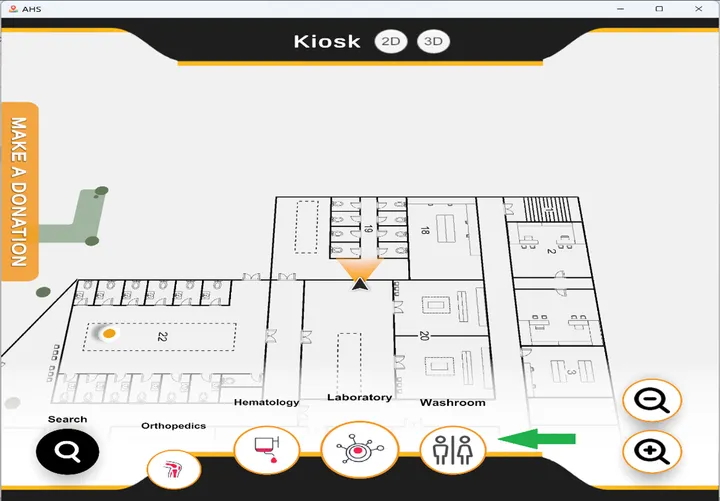
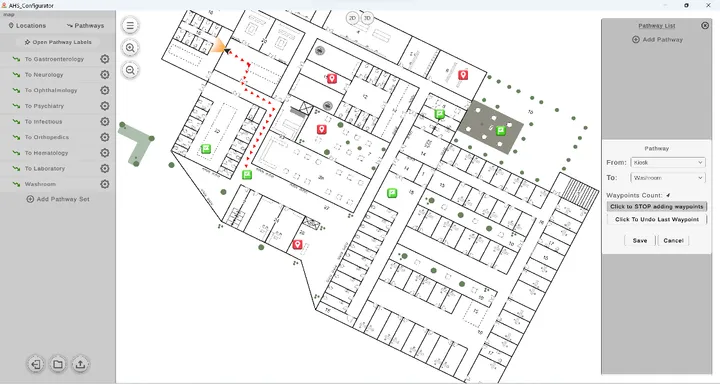
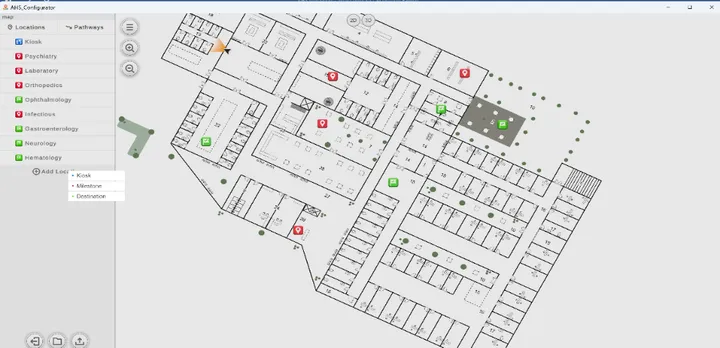
Departmental Navigation Software is an innovative product based on reinforcement learning-based navigation, which is one of the advanced artificial intelligence (AI) approaches. It was developed and delivered by H&M Soft Technology Corporation based on a specific order from FidaSys Inc. The software is designed for navigation within complex environments containing numerous similar and interconnected elements, such as hospitals and other large-scale facilities.
The innovative aspects include its priority-based routing system and virtual reality (VR) technology, the ability to identify complex and nested routes, dynamic adaptation to changes in environmental elements, and the capability to recognize and provide the most appropriate navigation paths. The product was developed using 3D Unity based on C#, enabling a sophisticated and interactive navigation environment for complex spaces — providing navigation and pathfinding in both 2D and 3D environments.
- Learns the building — routes improve through reinforcement learning, not manual maps.
- Respects priorities — a wheelchair user and a visitor are not given the same path.
- Adapts dynamically — closed corridors and moved departments are absorbed, not shipped around.
- Runs in VR — the interface lives on Quest devices, where the route is felt, not read.
The real software
From the headset to the control panel
For the technically curious
Under the hood
Reinforcement learning
The navigator is rewarded for arriving — and learns from every path it takes.
Priority-based routing
Routes carry weights: urgency and ability change the shortest path.
Dynamic adaptation
Environmental elements change; the graph re-weaves itself around them.
Unity 3D + C#
An interactive 3D environment — not a map image, a living model.
2D & 3D pathfinding
Flat floor plans and multi-level facilities, one engine.
VR on Quest
Orientation you can feel — the route rendered around the visitor.