Congestion → Flow
A city breathes through its vehicles. This software keeps the rhythm.
At airports, train stations and dense urban cores, taxis pile up where they are not needed and vanish where they are. This product redistributes the city — quietly, continuously.
The condition
A queue at the curb is the first impression of an entire region.
Travelers wait in one terminal while taxis idle in another zone. The vehicles are there; the information is not.
Every station restart — a power cut, a system update — used to mean a operator walking around re-launching software. And every unsecured display was one more door for unauthorized access.
The transformation
What the software actually does
The Smart Navigator & Traffic Manager for public transportation taxis serves airports, train stations, and high-density urban areas. It is based on dynamic arrays — one of the advanced AI approaches — and was developed and delivered by H&M Soft Technology Corporation based on a specific order from FidaSys Inc. Data is collected against predefined standards, and taxis are intelligently dispatched to less congested routes and stations to distribute them evenly throughout the city.
- A. Automatic Application Launch — the application starts itself once the required stations are powered on: no manual execution after power outages or system updates.
- B. Embedded Security — built-in security mechanisms establish secure communication with the Central Virginia Transportation Authority (CVTA) application, displaying the Queue Billboard while minimizing the risk of unauthorized access.
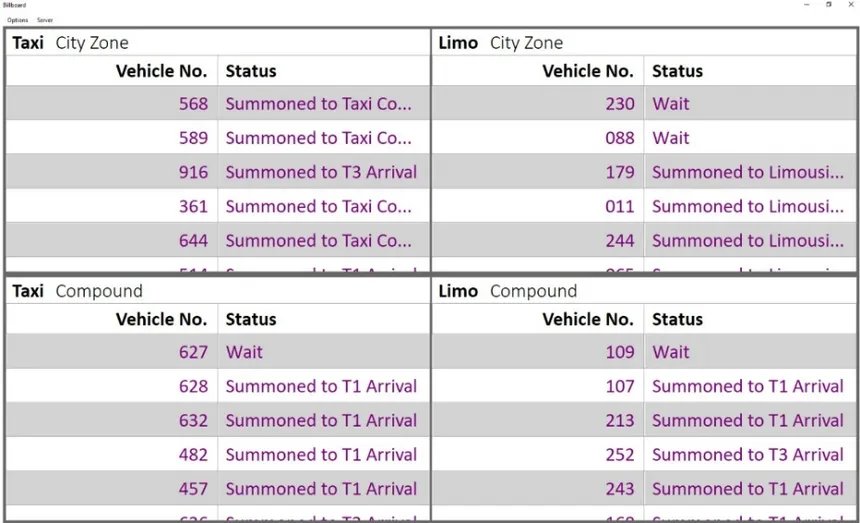
- C. Enhanced User Experience — side-by-side views for multiple vehicle categories and other operational views.
- Intelligent dispatching — data collected on predefined standards drives taxis toward less congested routes and stations, distributing them evenly across the city.
The real software
The Queue Billboard, live at the curb
For the technically curious
Under the hood
Dynamic arrays
Fleets change size by the minute; the data structures grow and shrink with them.
Embedded security
Secure channels to the CVTA application — the billboard shows queues, not vulnerabilities.
Self-starting stations
Power restored, software running — no operator round-trips.
Standard-based data collection
Every status change is captured against predefined standards.
Intelligent dispatching
Taxis are pulled toward less congested routes and stations — city-wide balance.
Side-by-side views
Taxi and limo, city zone and compound — one screen, multiple worlds.